Service Website Trust Signals: Build Credibility Before Visitors Inquire
-
 OppMint Team
 - 28 Jun, 2026
A service website does not convert because it has a contact button. It converts when the visitor believes three things: you understand their problem, you can help, and the next step will not waste their time.
Trust signals make those beliefs easier. They are the proof, process, examples, policies, and small details that reduce doubt before someone fills out a form, downloads a lead magnet, or books a call.
Why trust signals matter for service websites
Service buyers are usually not buying a fixed product. They are buying judgment, communication, reliability, and the possibility of a good outcome.
That creates uncertainty:
| Visitor concern | Trust signal that helps |
|---|---|
| “Can this person help my situation?” | Relevant examples and service fit notes |
| “Will this be expensive or vague?” | Pricing context and scope explanation |
| “Are they real?” | About section, credentials, visible contact path |
| “What happens after I inquire?” | Clear process and follow-up expectations |
| “Is this risky?” | Policies, guarantees, privacy notes, FAQ |
A trust signal should answer a real hesitation. If it does not reduce uncertainty, it is decoration.
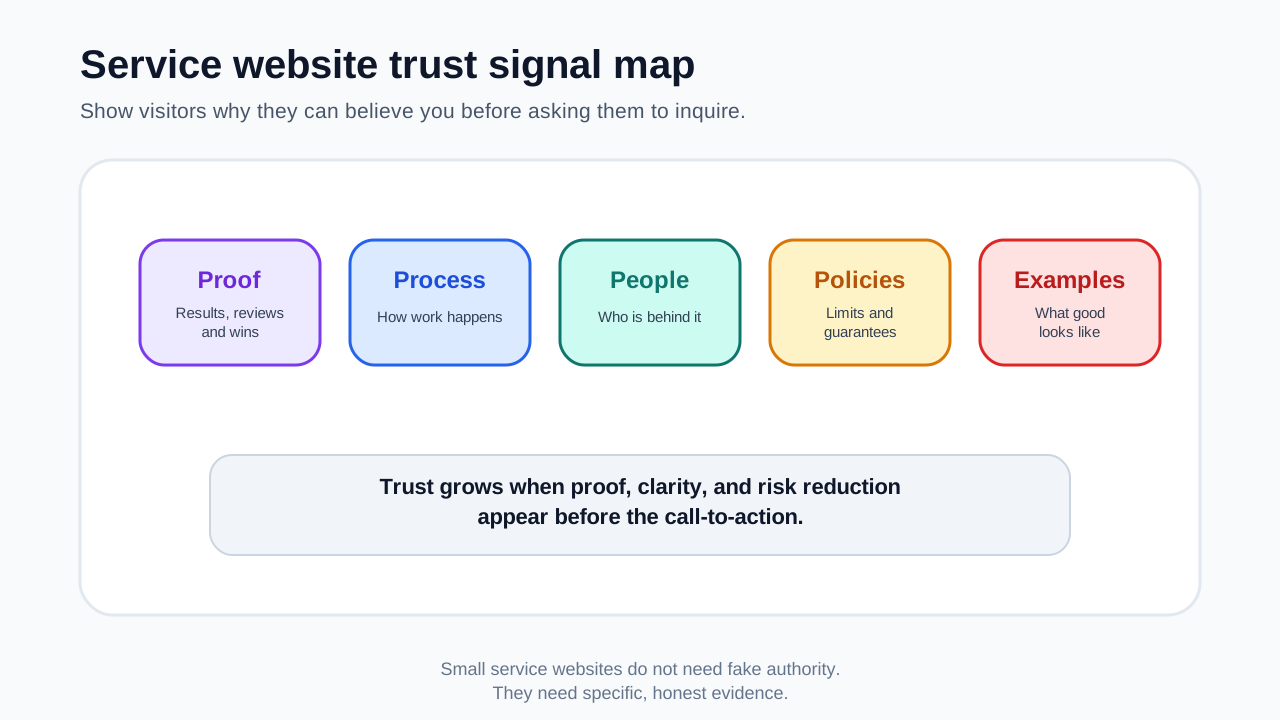
The trust signal map
Think of trust signals in five groups.
| Trust signal group | What it proves | Best placement | Risk |
|---|---|---|---|
| Proof | You have helped before | Service page, pricing page, case study section | Fake or vague claims reduce trust |
| Process | You know how the work happens | Service page, contact page, follow-up email | Too much detail can overwhelm |
| People | There is a real person or team behind the offer | About, homepage, footer, proposal page | Generic bios feel weak |
| Policies | The visitor knows the rules | Pricing, checkout, contact, privacy pages | Overly legal language creates friction |
| Examples | The visitor can imagine the result | Blog posts, service pages, lead magnets | Cherry-picked examples can mislead |
Most small service websites do not need every possible trust element. They need the right trust element near the moment of doubt.
Testimonials without making fake claims
Testimonials work when they are specific. They fail when they sound invented.
Weak testimonial:
Great service! Highly recommended.Better testimonial:
The audit helped us identify why our service page was getting traffic but not inquiries. We used the checklist to rewrite the offer and simplify the contact form.A useful testimonial usually includes:
- what problem the client had;
- what changed after the service;
- what part of the process helped;
- who the testimonial is from, when possible;
- no exaggerated revenue, ranking, or guaranteed outcome claims.
If you do not have testimonials yet, do not fake them. Use process proof instead: screenshots of deliverables, sample checklists, anonymized before/after examples, or a clear explanation of how you work.
Case studies when you only have small wins
A case study does not need to be a massive success story. For a small service business, a “case note” can be enough.
Structure:
| Section | What to write |
|---|---|
| Starting point | What was unclear or broken |
| Constraint | Budget, timeline, page count, platform, data limit |
| Action | What you changed or recommended |
| Result | What improved, or what decision became easier |
| Lesson | What similar clients should learn |
Small wins are still useful when they are honest. Examples:
- reduced form friction;
- clarified a service offer;
- reorganized a pricing page;
- found technical SEO issues;
- created a lead magnet for a specific audience;
- helped a founder decide not to build the wrong website.
Do not invent numbers. If you do not have measured results, say what was delivered and what changed in the decision process.
Process transparency and pricing context
Visitors trust a service provider more when they understand what happens next.
Your process does not need to be complex. A simple three-step model is often enough:
- Review the current website and goals.
- Identify the highest-impact trust, offer, and conversion gaps.
- Deliver a prioritized plan or implementation package.
Pair process with pricing context. You do not always need exact prices, but visitors should understand whether the service uses packages, starting ranges, custom quotes, or a diagnostic first step. If you already have a pricing page, connect it to the trust layer with Service Website Pricing Page Guide.
Trust drops when a website says “contact us” but gives no clue what happens after contact.
Risk reducers: FAQ, guarantees, privacy, and next-step clarity
Risk reducers are small details that make the next step feel safer.
| Risk reducer | Why it helps |
|---|---|
| FAQ | Answers objections before the form |
| Privacy note | Explains how form data is handled |
| Scope explanation | Prevents mismatch and scope creep |
| Timeline range | Reduces uncertainty |
| “Not a fit” section | Filters bad leads honestly |
| Response expectation | Tells visitors when and how you reply |
| Simple guarantee | Clarifies what is and is not promised |
Be careful with guarantees. Do not guarantee rankings, income, or lead volume. A safer guarantee is about process, communication, revision scope, or deliverable clarity.
Where to place trust signals
Do not put every trust signal in one section called “Why trust us.” Place proof near the decision it supports.
| Page area | Trust signal to place there |
|---|---|
| Hero section | Clear audience, outcome, and credibility cue |
| Service description | Relevant examples and process summary |
| Pricing page | Scope, proof, fit, and risk reducers |
| Contact form | Response expectation and privacy note |
| Lead magnet page | Preview of what the visitor will receive |
| Follow-up sequence | Helpful examples before the call invite |
| Footer | Business identity, contact, policy links |
If a visitor reads your Service Website Follow-Up Sequence, the emails should continue the same trust pattern: useful help first, invitation later.
Minimum trust layer checklist
Before asking visitors to inquire, check that the website has at least this minimum layer:
- A clear statement of who the service is for.
- A clear statement of who it is not for.
- One example, case note, or sample deliverable.
- A short process explanation.
- Pricing context or a link to the pricing page.
- A contact form that does not ask too much too soon.
- A privacy note near the form.
- FAQ covering scope, timeline, price, and next step.
- No fake testimonials, fake statistics, or guaranteed income claims.
This checklist connects naturally with Service Website Contact Form Questions: the form should collect enough context, while the page around it reduces fear.
Mistakes to avoid
- Using vague testimonials that sound fake
- Hiding all pricing context
- Saying “trusted by clients” without proof
- Adding badges that are not real credentials
- Promising rankings, revenue, or guaranteed leads
- Asking for a call before explaining the process
- Making the contact form feel like an interrogation
- Placing proof only at the bottom of the page
Trust is not a design element you add at the end. It is part of the whole funnel.
Related guides
If you are building the full service website funnel, use these next:
- Service Website Lead Magnet Strategy
- Service Website Pricing Page Guide
- Service Website Contact Form Questions
- Content Website Service Lead Funnel
FAQ
What are trust signals on a service website?
Trust signals are elements that reduce doubt before a visitor inquires. Examples include testimonials, case studies, process explanations, pricing context, policies, privacy notes, examples, and clear next steps.
What if I do not have testimonials yet?
Use process proof and sample deliverables. Show how you think, what a client receives, what the first step looks like, and what problems you are qualified to diagnose. Do not create fake testimonials.
Should trust signals go on every page?
Not every page needs every trust signal. Place the right proof near the decision point: service pages need examples, pricing pages need scope and fit, contact pages need response expectations and privacy context.
Can guarantees improve trust?
Yes, if they are honest and limited. Guarantee clarity, response time, revision scope, or deliverable quality. Do not guarantee rankings, revenue, leads, or income.
Final take
A service website trust layer should make the next step feel reasonable. Show honest proof, explain the process, reduce risk, and make it clear what happens after the visitor acts. You do not need fake authority. You need specific evidence placed where doubt appears.