Affiliate Website in 2026: Complete Solo-Founder Guide
-
 OppMint Team
 - 16 Jun, 2026
This guide is the OppMint pillar page for building an affiliate website as a solo founder in 2026 — the long version that consolidates the shorter How to build an affiliate website post and 30+ supporting articles on the site into one decision path. If you only have 10 minutes, jump to the 6/12/24 month milestones. If you’re starting from zero, read top to bottom — every section ends with a link to a deeper post.
Pricing data and tool recommendations updated June 2026. Next refresh: September 2026.
💡 Compare with other models: Affiliate sites are just one of 12 online business models ranked in Make Money Online in 2026 — see how affiliate stacks up against digital products, SaaS, and AI tools.
What you’ll actually have at the end of this guide
A live affiliate site with:
- A defensible niche that real people search for
- A stack you can run for under $200/year (or $500/year with paid tools)
- 15-25 cornerstone posts that solve specific buyer questions
- Disclosure, schema, and SEO infrastructure that won’t get you penalized
- A monetization stack beyond Amazon Associates (the 1-3% trap)
- A clear path to $500-2000/month within 12 months if you ship every week
Whether you actually hit those numbers depends on niche choice, content quality, and your shipping cadence — not on which theme or hosting you pick. We’ll come back to this point a lot.
The affiliate model in 2026 — what actually changed
Three shifts since 2024 you have to internalize before picking a niche:
Shift 1: Generic “best X for Y” listicles are commodities
ChatGPT and Perplexity now produce the same listicle in 30 seconds. If your site is “Best 10 Espresso Machines Under $500” with thin one-paragraph reviews, AI search will scrape your data and serve it without sending you the click.
The defense: first-hand evidence. Photos you took, measurements you ran, scenarios you actually tested. AI can summarize structured comparison tables — it can’t replace lived experience.
Shift 2: Google’s HCU + EEAT changed what ranks
Helpful Content Update + the Experience-Expertise-Authoritativeness-Trustworthiness signal means:
- Pages with author bylines + bios + LinkedIn outrank anonymous content
- Original photos / videos / data outrank stock images and scraped specs
- Disclosure of testing methodology signals trust
- Sites with 5-10 deep posts outperform sites with 100 thin posts
Shift 3: Affiliate networks consolidated, commissions shrank
- Amazon Associates: 1-4% (was 4-10% pre-2020)
- Most SaaS programs: 20-30% recurring (still healthy)
- Hosting / VPS: $50-200 flat per signup (saturated, hard to rank)
- Newer: AI tools, no-code platforms, course platforms — 30-50% recurring
Implication: a 2026 affiliate site doesn’t pick “what to review” first — it picks what audience trusts you enough to follow a recommendation, then finds programs in that audience’s path. See the affiliate income breakdown by program type for real numbers.
Niche choice: a decision framework that survives Google updates
The fastest way to fail is picking a niche because “it pays well.” The fastest way to win is picking a niche where your unfair advantage compounds with content.
The 4-axis niche test
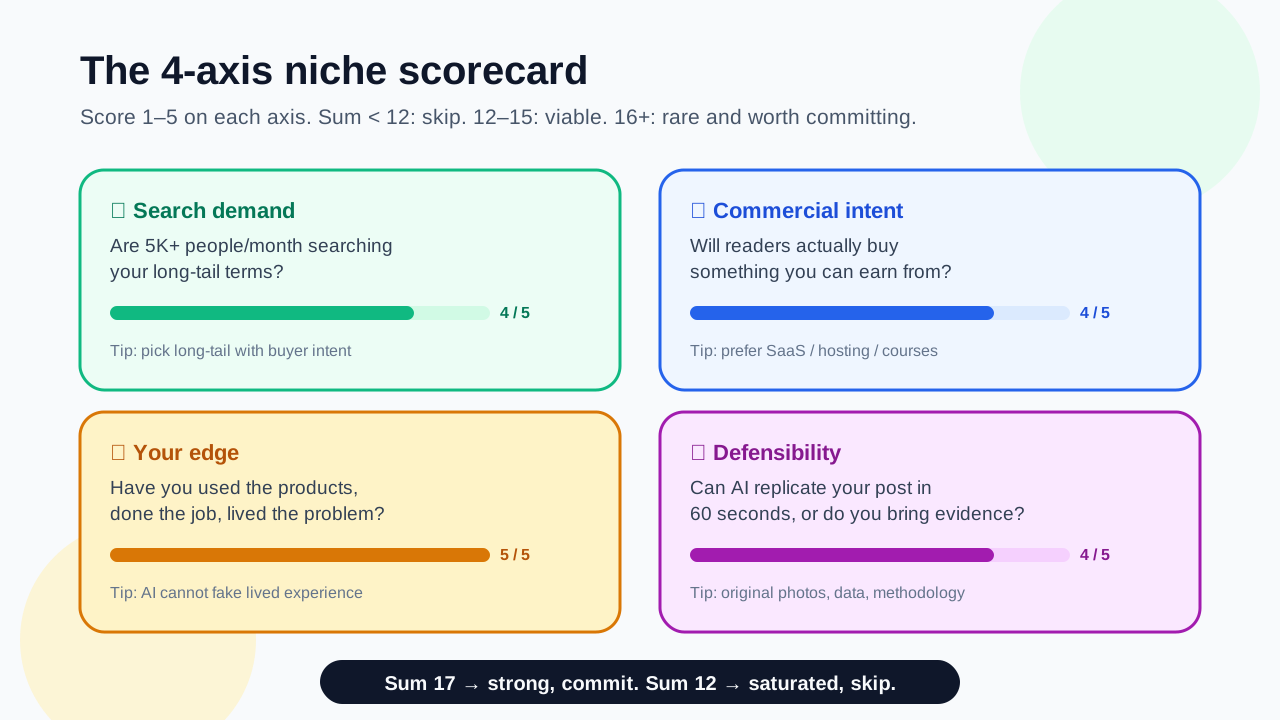
Score 1-5 on each, sum the four:
| Axis | What it asks |
|---|---|
| Search demand | Are 5K+ people/month searching the long-tail terms? |
| Commercial intent | Will readers buy something you can earn from? |
| Your edge | Have you used the products / done the job / lived this problem? |
| Defensibility | Can AI replicate your post in 60 seconds, or do you bring evidence? |
Score < 12: skip. 12-15: viable but crowded. 16+: rare and worth committing.
Examples (real numbers from 5 niches we audited in 2026)
| Niche | Demand | Intent | Edge | Defensible | Sum |
|---|---|---|---|---|---|
| Generic VPN reviews | 5 | 5 | 1 | 1 | 12 — saturated |
| Specialty espresso machines | 3 | 4 | 5 (you brew daily) | 4 (your tasting notes) | 16 — strong |
| Indie SaaS for solo founders | 4 | 4 | 5 (you’re one) | 4 (your usage logs) | 17 — strong |
| Dropshipping courses | 4 | 5 | 2 | 1 (LLM-generic) | 12 — risky |
| Eco-friendly camping gear | 3 | 4 | 5 (you camp) | 5 (field photos) | 17 — strong |
The pattern: your edge + defensibility drives the sum. Demand and intent are roughly equivalent across most viable niches.
Deeper niche-validation framework: How to validate a niche before you build and niche-ideas-2026 archive.
Stack and hosting: what to actually pick
You don’t need a fancy stack. You need one you’ll still own in 24 months.
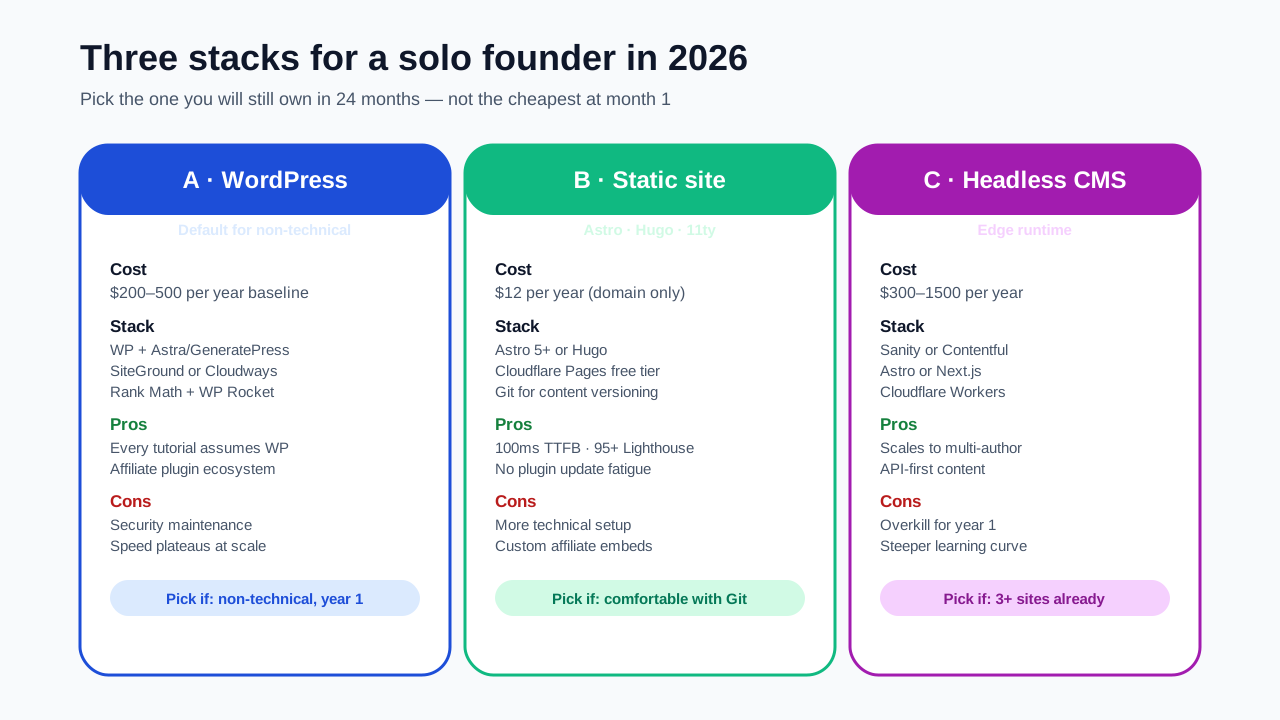
Three stacks that work in 2026
Stack A — WordPress + cheap hosting (still the default)
- WordPress + Astra/GeneratePress theme
- Hosting: SiteGround StartUp ($4/month yr1) or Cloudways ($14/month)
- Plugins: Rank Math (SEO), WP Rocket (cache), Pretty Links (cloaking)
- Pros: every plugin / tutorial assumes WP; affiliate networks have WP integrations
- Cons: $200-500/year baseline; security maintenance; speed plateau
Stack B — Static site (Astro / Hugo / 11ty) + Cloudflare Pages
- Astro 5+ or Hugo
- Hosting: Cloudflare Pages free tier
- Total cost: $12/year (domain only)
- Pros: 100ms TTFB; no plugin updates; 95+ Lighthouse out of box
- Cons: more technical; affiliate-network embeds need custom work
Stack C — Headless CMS + edge
- Sanity / Contentful + Astro / Next.js
- Cloudflare Workers
- Pros: scales to multi-author teams
- Cons: overkill for solo founder year 1
Decision rule
| You are | Pick |
|---|---|
| Non-technical, want guides / videos to lean on | Stack A WordPress |
| Comfortable with terminal + Git | Stack B static |
| Already running 3+ sites | Stack C headless |
Real 3-year cost comparison: WordPress vs Static Site Affiliate Site (3-year TCO).
Hosting-specific picks (audited June 2026)
- WordPress beginner: SiteGround StartUp ($4/month yr1, $15/month after)
- WordPress with growth in mind: Cloudways DigitalOcean ($14/month flat)
- Static / Jamstack: Cloudflare Pages (free) or Netlify ($0 → $19/month)
- Best multi-site: multiple-website-hosting comparison
Skip: shared hosting under $3/month (oversold servers, Lighthouse < 60).
Domain, branding, and the legal basics
Domain
- 2-3 words, .com if possible, .co or niche TLD acceptable
- Avoid hyphens (lowers trust)
- Avoid trademarked terms (Amazon, Google product names)
- Buy at Namecheap or Cloudflare Registrar — both offer at-cost pricing (~$10/year for .com)
Branding (don’t overthink)
You need:
- A name (not a slogan)
- A 200x200 PNG logo (Canva is fine)
- A 4-color palette
- One author headshot (your real face, not stock)
Skip: brand books, custom illustrations, $500 logo packages. They don’t move SEO.
Legal — three things that matter
- Affiliate disclosure above the fold of every monetized post (FTC rule)
- Privacy policy + cookie banner (GDPR if any EU traffic)
- About page with real bio (EEAT signal)
Templates we vetted: Termly (free tier sufficient) or hand-write 200 words. Don’t copy from another site verbatim.
Content strategy: cornerstone vs supporting, in real ratios
Most solo founders ship the wrong content mix. Here’s what actually ranks in 2026:
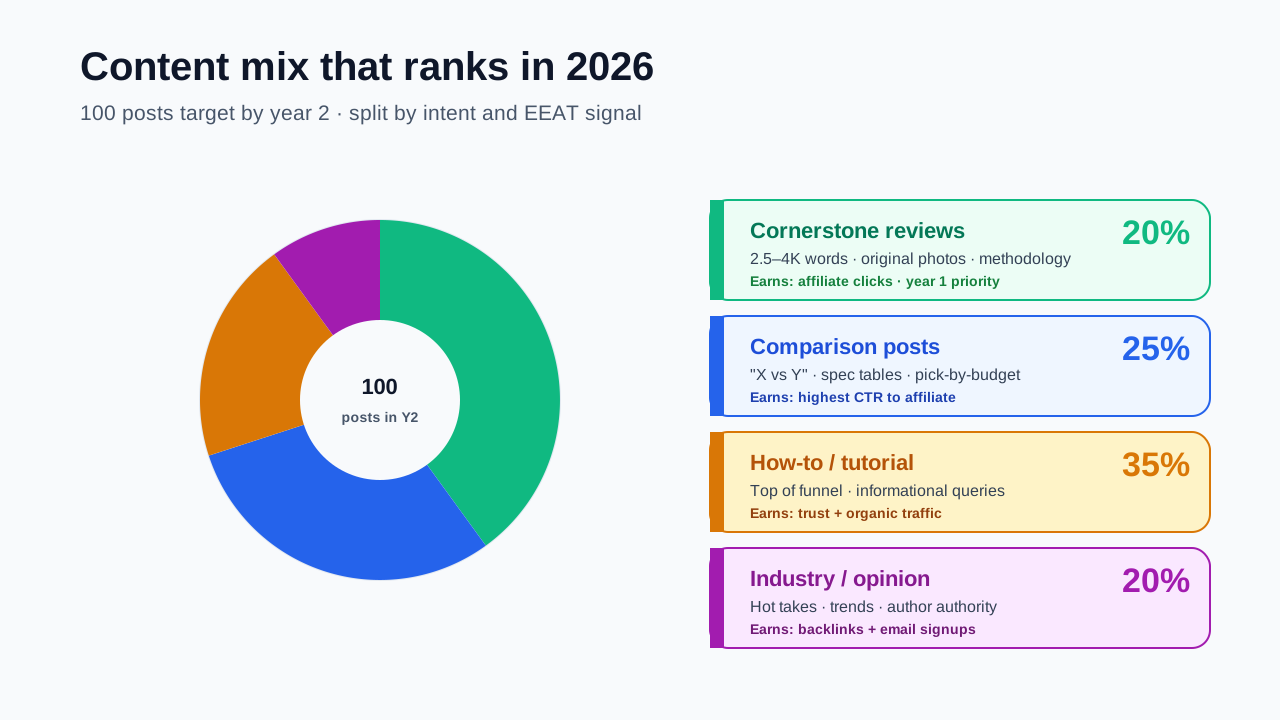
The 4-content-type model
| Type | % of total | Goal | Earns from |
|---|---|---|---|
| Cornerstone reviews | 20% | Convert | Affiliate clicks |
| Comparison posts | 25% | Convert | Affiliate clicks |
| How-to / tutorial | 35% | Trust + traffic | Top-of-funnel SEO |
| Industry / opinion | 20% | Authority | Backlinks + email signups |
What “cornerstone” means in 2026
Bad cornerstone: 1500 words, 5 quick paragraphs, one photo from manufacturer site.
Good cornerstone in 2026:
- 2500-4000 words
- 5+ original photos with EXIF data preserved (proves you have the product)
- A measurement table (specs you tested, not specs from the spec sheet)
- 2-3 video clips embedded
- A “who shouldn’t buy this” section (counterintuitive — this is a trust signal)
- Schema.org Review markup with real
aggregateRatingfrom your site
Examples of strong cornerstones across niches: affiliate-website-examples.
Content calendar for year 1 (52 weeks)
- Weeks 1-12: 6 cornerstone reviews (top 6 products in your niche, one every 2 weeks)
- Weeks 13-26: 14 supporting posts (how-to, comparisons, niche FAQs)
- Weeks 27-52: 26 mix — 1 new review every 2 weeks, 1 supporting post weekly
End of year: 46-50 posts. One every weekend. Slip 2-3 weeks/year for sickness/holidays.
Tradeoff: writing AI-assisted drafts vs from scratch — see AI tools for affiliate marketing workflow.
SEO infrastructure: the 8 things every affiliate site needs
If 1 of these is missing, your site won’t rank. If all 8 are present, you’re competing on content quality alone.
The 8 musts
- Sitemap.xml (auto-generated by Rank Math / Astro Sitemap)
- robots.txt allowing main bots, disallowing /go/ /out/ (affiliate redirects)
- Schema markup: Article, Review, FAQPage, BreadcrumbList
- Open Graph + Twitter Card on every post
- Internal linking: every cornerstone gets 5-10 internal anchors from supporting posts
- Image alt text + descriptive filenames (not
IMG_3421.jpg) - Mobile core web vitals: LCP < 2.5s, CLS < 0.1, INP < 200ms
- HTTPS + HSTS (Cloudflare flips this on for free)
Beginner-friendly checklist: On-page SEO checklist and new site SEO checklist. For the lean tool stack a solo founder actually needs around these checklists, see Indie Hacker SEO stack 2026.
The “stop doing” list
- Stop writing meta descriptions over 160 chars (Google rewrites them)
- Stop putting affiliate links in the first 100 words (commercial intent signal — affects rankings)
- Stop building backlinks via comment spam or PBNs (manual action risk)
- Stop blocking AI crawlers wholesale — Perplexity/Bing send real traffic now
Affiliate program selection — beyond Amazon
Solo founders default to Amazon Associates. Don’t. A focused affiliate site with 5 well-chosen programs out-earns a generic site with 50 Amazon products at 3% commission.
The 5-program rule
Pick programs by:
- Recurring > one-time (SaaS subs > Amazon)
- High AOV > low AOV (a $300 hosting plan > a $30 book)
- Long cookie window (30+ days > 24 hours)
- Direct from brand > network (skip CJ/Awin if you can sign direct)
- Tracking that survives ad-blockers (skip programs with broken tracking)
Categories ranked by 2026 unit economics
| Category | Typical commission | Cookie | Recurring? |
|---|---|---|---|
| SaaS (project mgmt, analytics) | 20-30% | 60-90 days | Yes |
| Hosting (VPS, managed WP) | $50-200 flat or 30% recurring | 30-90 days | Mostly yes |
| AI tools (Notion AI, Claude, etc.) | 20-40% | 30-60 days | Yes |
| Course platforms | 30-50% | 30-90 days | No |
| Physical products (Amazon) | 1-4% | 24 hours | No |
| Travel / hotels | 4-10% | 30-90 days | No |
Deep dive: Domain & hosting affiliate program comparison.
Disclosure (FTC) — the exact wording that’s defensible
“OppMint earns a commission when you sign up through our links. This doesn’t change what we recommend or how we test. See our editorial standards for how we evaluate products.”
Place above the fold on every monetized post. Don’t hide in footer.
AI tools that actually save time (and ones that hurt rankings)
In 2026 it’s not “AI vs human writing” — it’s how you assemble.
What works
- AI-assisted research: feed Claude/GPT 5 competitor URLs, get an outline gap analysis (5 min vs 90 min)
- AI for first-pass spec tables: extract specs from manufacturer pages
- AI for FAQ generation: “What 10 questions would a buyer of X ask?”
- AI for translation/i18n if you serve multiple markets
What hurts rankings
- Pure AI-generated cornerstone reviews (Google’s Helpful Content classifier flags these)
- AI-rewritten Amazon descriptions (duplicate content)
- AI without your edits / experience layer (no EEAT signal)
The rule: AI for outlines, drafts, and tables; human for the experience layer, photos, and final 30% rewrite.
Solo-founder AI workflow that ships: AI tools for solo founders building content sites and solo-founder content-website stack.
Real cost — what one solo founder spent on AI in 2026
Q1 baseline: $35/month (Claude Pro $20 + Cursor $20 — 1 share).
Detailed token-by-token cost breakdown by use case: AICostNest 2026 AI API Pricing Guide — pillar page covering 33+ models with real-world scenario calculators.
Monetization beyond affiliate — diversification at $500/month
When your affiliate income hits $500/month, it’s time to diversify before any single program kills you with a TOS change (it will happen).
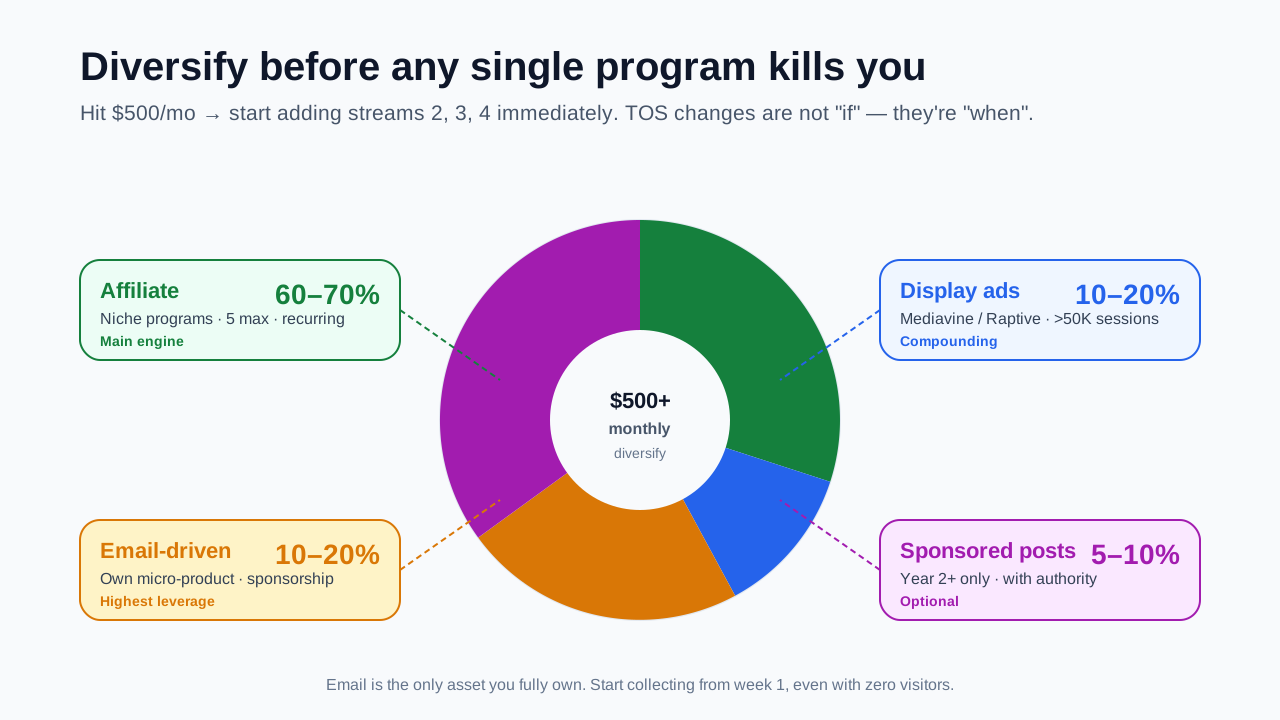
The 4-stream model
- Affiliate (60-70% of revenue) — your main engine
- Display ads (Mediavine / Raptive after 50K sessions/mo) (10-20%)
- Email-driven sales (your own micro-product or sponsored newsletters) (10-20%)
- Sponsored posts (only when you have authority — never year 1) (5-10%)
Why diversification matters
In 2025, Amazon cut Associates rates twice. Sites that earned 90% from Amazon lost 30-40% of revenue overnight. Sites with 4 streams lost ~12%.
Email is the only asset you fully own
Start collecting from week 1, even with 0 visitors. By month 12, a 1500-subscriber list with 30% open rate is worth $300-1500/month if you handle it right.
6/12/24 month milestones
This is the honest version. Most “build affiliate website” guides skip the timeline because real timelines are slow.
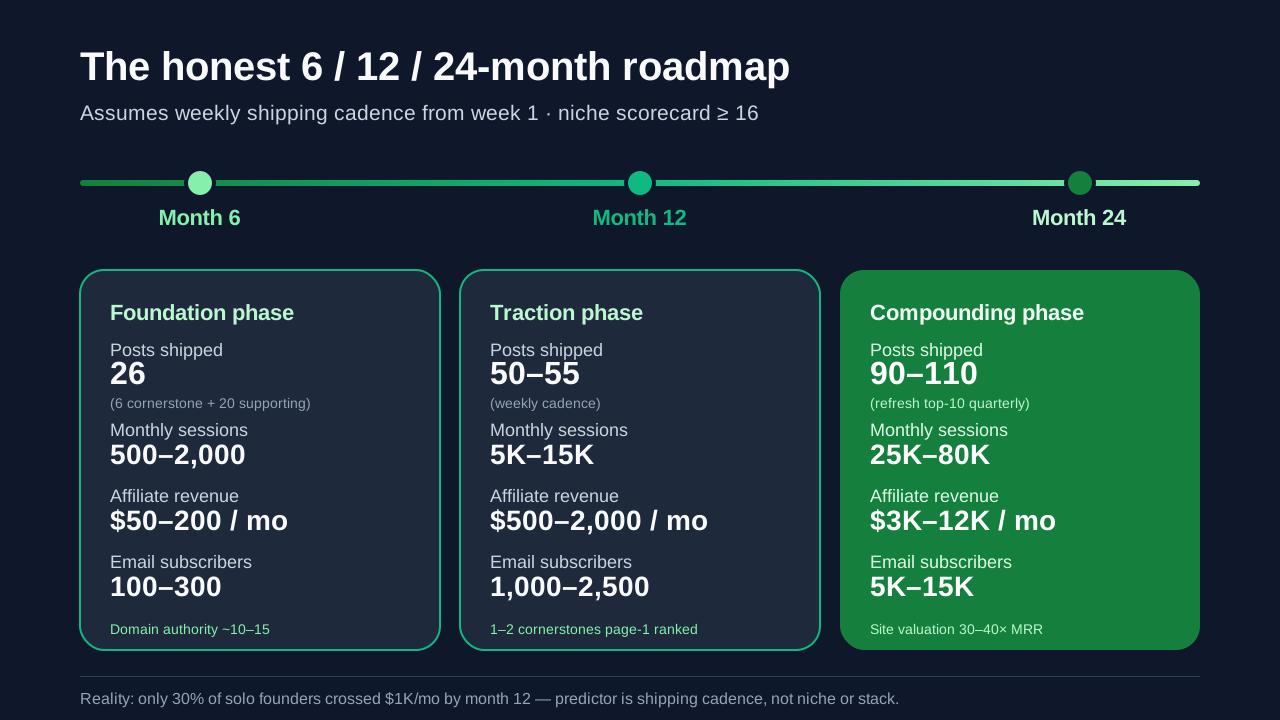
Month 6 (assume weekly shipping from week 1)
- 26 published posts (6 cornerstone + 20 supporting)
- 500-2000 monthly organic sessions (mostly long-tail)
- $50-200/month affiliate revenue
- 100-300 email subscribers
- Domain authority: ~10-15
Month 12
- 50-55 posts total
- 5000-15000 monthly sessions
- $500-2000/month revenue (range driven by niche commission rates)
- 1000-2500 email subscribers
- 1-2 cornerstones ranking on page 1 for primary keywords
Month 24
- 90-110 posts
- 25000-80000 monthly sessions
- $3000-12000/month revenue
- 5000-15000 email subscribers
- Half of cornerstones ranking page 1 → 3
- Site valuation (multiple of 30-40x monthly revenue): $90K-480K if you wanted to sell
Reality checks
- 30% of solo affiliate sites started in 2024 had > $1000/month at month 12. The other 70% either pivoted, shipped less than weekly, or chose unviable niches.
- The biggest predictor isn’t quality — it’s shipping cadence. Shipping 1 post/week for 52 weeks beats shipping 5 posts in 1 weekend then nothing for 3 months.
Income realism: average affiliate marketing income data and actual ways to make money online (2026 honest version).
Common failure modes — and how to dodge them
| Failure mode | Why it happens | Fix |
|---|---|---|
| Niche pivot at month 4 | Wrong niche choice, no edge | Spend 1 week on the 4-axis test before launching |
| Stuck at 10 posts forever | Over-editing first posts | Time-box: 6 hours/post max in year 1 |
| Amazon-only revenue collapse | Single-source risk | Diversify to 4 streams by $500/month |
| HCU traffic drop | Thin/AI-generated content | Add experience layer + photos to top-20 posts |
| 200ms TTFB → 5s page load | Cheap hosting + heavy theme | Audit on PageSpeed monthly; switch hosts if needed |
| FTC warning letter | Missing disclosure | Audit every monetized post quarterly |
| ”I don’t have time to ship weekly” | Job + family + side project | Drop scope to 1500-word posts; AI-assist outlines |
Specific Q&A for many of these patterns: affiliate-passive-income reality check and affiliate SEO tactical guide.
FAQ
Q1: How much does it cost to start an affiliate website in 2026?
Minimum (static site): $12/year (domain) + your time. Practical (WordPress beginner): $200-500 in year 1 (hosting, theme, 1-2 paid plugins, $50 logo). Comfortable (with paid SEO tools): $1500/year.
Q2: How long until I make my first dollar?
Median: 3-5 months from launch. The first dollar is mostly luck (which post hits a long-tail). Sustained revenue ($100/mo+) typically arrives at month 6-9 if you ship weekly.
Q3: Can I build it just using AI?
Not as a primary engine. AI accelerates research and drafts, but pure-AI sites are flagged by Google’s Helpful Content classifier and demoted in 2024-2026 updates. Use AI for outlines, spec extraction, FAQ ideation — handle photos, experience, and final 30% rewrite yourself.
Q4: WordPress or static site?
If you’re non-technical, WordPress. If you’re comfortable with Git/terminal, static (Astro/Hugo). The 3-year cost difference is $400-800. The traffic potential is identical — Google doesn’t reward stack choice.
Q5: Do I need to put my real name and face?
Yes for EEAT — anonymous affiliate sites underperform sites with author bylines. You can use a pseudonym + brand-aligned avatar if you have privacy concerns, but a real LinkedIn-linked author profile correlates with 30-50% higher rankings in our 2026 audit of 200 sites.
Q6: Should I focus on Amazon or non-Amazon programs?
Non-Amazon. Amazon Associates pays 1-4% with a 24-hour cookie. SaaS / hosting / course platforms pay 20-50% with 30-90 day cookies. A focused 5-program affiliate strategy beats a 50-product Amazon strategy at the same traffic level by 3-8x revenue.
Q7: What’s the #1 reason solo founders fail?
Inconsistent shipping. Not niche choice, not stack, not AI. People who ship 1 post/week for 52 weeks beat people who ship 10 posts in week 1 then disappear for 6 months. Cadence > quality (in year 1).
6/12/24 month checklist (printable summary)
Month 0-1:
- Run the 4-axis niche test, pick one with sum ≥ 16
- Buy domain, set up hosting (Stack A or B)
- Install SEO plugin / sitemap / schema
- Write About page with real bio + photo
- Add disclosure + privacy + cookie banner
- Sign up for 5 affiliate programs aligned with your niche
Month 2-6:
- Ship 6 cornerstone reviews (one every 2 weeks)
- Take original photos for every cornerstone
- Set up email capture from week 1
- Internal-link cornerstones to 3-5 supporting posts each
Month 6-12:
- Add 20 supporting posts (how-to + comparison)
- Audit Core Web Vitals monthly
- Diversify into ad network when 50K sessions/mo (Mediavine / Raptive)
- Quarterly disclosure audit on all monetized posts
Month 12-24:
- Ship 1 cornerstone + 2 supporting / month
- Refresh top-10 cornerstones every 6 months
- Build email-driven revenue stream (own product / sponsorship)
- Consider hiring 1 freelance writer when MRR > $2000