How to Choose a Website Niche You Can Actually Maintain in 2026
-
 OppMint Team
 - 26 Jun, 2026
A good website niche is not just profitable on paper. It has to be something you can keep improving for 6-12 months without running out of useful pages, trust, or energy.
Most niche advice tells you to follow your passion, chase high CPC keywords, or copy what already ranks. That is incomplete. A niche can have search volume and monetization potential and still be a bad choice if it requires expert credentials you do not have, weekly updates you cannot maintain, or 200 articles before the site makes sense.
This guide gives you a maintainability test for choosing a website niche in 2026. Use it before you buy a domain, build the site, or write the first 30 posts.
The 5-part maintainability test
Before asking “is this niche profitable?” ask whether it is maintainable. Score each area from 1 to 5.
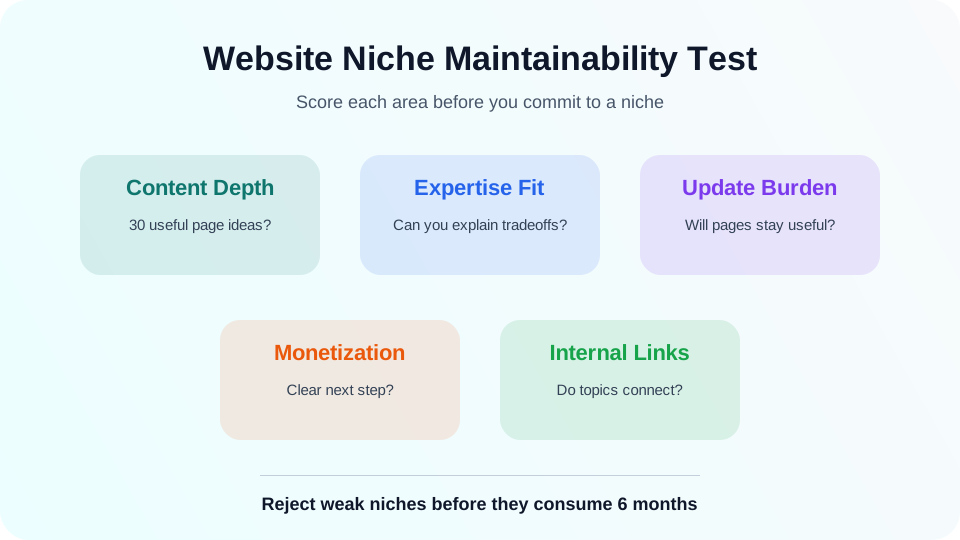
| Test | Good sign | Bad sign |
|---|---|---|
| Content depth | You can list 30 useful page ideas without repeating yourself | You can only think of 5 generic posts |
| Expertise fit | You can explain tradeoffs honestly | You would need fake authority or risky claims |
| Update burden | Most pages stay useful for 12+ months | Prices, laws, products, or rankings change constantly |
| Monetization path | Clear affiliate, service, lead, tool, or product route | Traffic is the only plan |
| Internal linking | Topics naturally connect | Every page feels isolated |
A niche does not need a perfect score. But if it scores low on content depth and expertise fit, it is usually not a beginner-friendly niche.
Can you produce 30 useful pages without repeating yourself?
This is the fastest test. Open a blank document and list 30 pages that would help a real reader.
Not titles stuffed with keywords. Real pages.
For example, a weak niche list looks like this:
- best productivity tools;
- productivity tips;
- productivity apps;
- productivity hacks;
- how to be productive.
Those are variations of the same idea. A stronger niche expands into different questions:
- beginner setup guide;
- tool comparison;
- troubleshooting checklist;
- cost breakdown;
- template or calculator;
- mistakes to avoid;
- alternatives for different user types;
- maintenance guide;
- decision matrix;
- first 30-day plan.
If you cannot build 30 useful pages, the niche may be too narrow, too shallow, or too far from your real knowledge.
If you need a broader idea list first, start with Business Website Ideas for Small Income Sites or Blog Content Strategy, then come back and score only the ideas that can support a content cluster.
Does the niche require expert credentials or constant updates?
Some niches are attractive because the audience has urgent problems. But urgency often comes with responsibility.
Be careful with niches involving:
- medical decisions;
- legal advice;
- tax filing;
- investment recommendations;
- safety-critical equipment;
- highly regulated services.
You can still build in these areas if you have real expertise or work with qualified reviewers. But if the plan is to publish generic AI-written advice, reject it.
Also check update burden. A niche where every article changes monthly may become a job you cannot keep up with. Examples:
| Niche type | Maintenance burden |
|---|---|
| ”Best AI tools this week” | Very high |
| Hosting pricing comparisons | Medium to high |
| Local service education | Medium |
| Evergreen workflow tutorials | Lower |
| Simple calculator/tool pages | Lower after launch |
A beginner site usually needs a mix: some fresh pages for growth, but enough evergreen pages to avoid constant rewrites.
Is there a clear monetization path?
Do not choose a niche only because traffic exists. Decide how the website can create value.
Common paths:
| Model | Works when | Maintenance risk |
|---|---|---|
| Affiliate content | Readers compare products or tools | Requires updates, disclosure, honest criteria |
| Service lead generation | Problem is valuable and trust matters | Requires strong contact flow and proof |
| Display ads | Broad informational traffic exists | Needs high traffic, slow early revenue |
| Digital products | Audience repeats a workflow | Requires product support and updates |
| Tool/content hybrid | A tool solves part of the search intent | Requires product maintenance |
A niche is stronger when one monetization path is obvious but not the only option. For example, a small business website niche might support service leads first and templates later. A software comparison niche might support affiliate links, but only if you can keep recommendations honest and updated.
If you are deciding between affiliate and lead generation, read Affiliate Content vs Service Lead Generation before choosing the model.
Can you build internal links naturally?
A maintainable niche should form a map, not a pile of disconnected posts.
Ask:
- What is the main beginner page?
- What comparison pages support it?
- What troubleshooting pages answer follow-up questions?
- What templates, calculators, or checklists help readers act?
- What page should a reader visit next?
A healthy content cluster might look like this:
Main guide
  → beginner checklist
  → cost breakdown
  → tool comparison
  → mistakes to avoid
  → template / calculator
  → advanced workflow
  → service or affiliate decision page
If every article has to link back to the homepage because nothing else connects, the niche may be too scattered.
Can you survive without paid traffic?
Paid traffic can validate offers, but a beginner content site should not depend on it from day one. If every visitor costs money and the site has no organic path, your niche choice needs a stronger revenue model.
For an SEO-driven site, check:
- Are there informational queries with clear problems?
- Are competitors beatable with better structure, examples, or tools?
- Are search results full of thin content, outdated pages, or forum threads?
- Can you publish something genuinely more useful than the top 10 results?
A niche with low competition but no demand is not an opportunity. A niche with demand but impossible competition may also be wrong for a beginner.
Use the pre-build checks from How to Validate a Website Business Idea Before You Build It before committing.
Niche examples: maintainable vs risky
| Niche idea | Maintainability | Why |
|---|---|---|
| Website setup for local service businesses | Strong | Clear audience, service path, many practical pages |
| Weekly AI tool news | Risky | High update burden, hard to build durable authority |
| Beginner WordPress maintenance for small businesses | Strong | Clear pain points, service leads, evergreen checklists |
| Generic “make money online” blog | Weak | Too broad, high competition, unclear trust angle |
| Budget SEO stack for solo founders | Strong | Clear audience, tool comparisons, content clusters |
| Crypto investment tips | Risky | Trust, compliance, and volatility problems |
| Free calculators for a specific workflow | Strong if useful | Tool pages can solve repeatable intent |
The pattern is simple: maintainable niches have a specific audience, repeated problems, natural internal links, and a clear next step.
A simple niche scoring table
Score each category from 1 to 5. Reject most ideas below 16 unless you have a strong non-SEO distribution channel.
| Category | Score 1 | Score 3 | Score 5 |
|---|---|---|---|
| Audience clarity | Everyone | Broad group | Specific user with known problem |
| Content depth | Under 10 pages | 15-25 pages | 30+ useful pages |
| Expertise fit | You would fake it | You can research it | You can explain tradeoffs honestly |
| Monetization | None | Ads only | Clear service/affiliate/tool/product path |
| Maintenance | Constant rewrites | Some updates | Mostly evergreen with planned refreshes |
| SEO reality | Impossible or no demand | Mixed | Reachable queries and weak content gaps |
Example decision:
Total score 24-30: strong candidate
Total score 18-23: possible, validate carefully
Total score 12-17: risky, narrow or adjust angle
Below 12: reject for now
How to turn one niche into a first 10-page cluster
Once a niche passes the test, do not start with random posts. Build a small cluster.
A practical first 10 pages:
- Main beginner guide;
- Idea validation checklist;
- Cost breakdown;
- Tools or stack comparison;
- Mistakes to avoid;
- Example workflow;
- Template or calculator page;
- Monetization comparison;
- Maintenance checklist;
- FAQ or troubleshooting guide.
For a service-focused niche, include a page that explains the contact or quote process. For an affiliate niche, include a comparison page with honest fit criteria and alternatives. For a tool/content niche, make the tool page the center and write supporting explanations around it.
The goal is not to publish 10 pages at once. The goal is to know whether the niche can become a site, not just one article.
Reject this niche if…
Reject or reshape the niche if any of these are true:
- You cannot list 30 useful pages without repeating the same advice;
- The niche requires credentials you do not have;
- The content becomes outdated every few weeks;
- There is no clear reader next step;
- Monetization depends only on massive ad traffic;
- Every top result is written by major brands with stronger trust;
- You would need to make income claims you cannot support;
- You do not want to maintain the site for at least 6 months.
Rejecting a niche is progress. It saves you from building a site that technically launches but never becomes useful.
Final checklist before choosing
Before you commit, answer these:
- Who exactly is this site for?
- What problem will the first 10 pages solve?
- Which page becomes the main hub?
- What is the first monetization path?
- What proof or experience do you need to be trustworthy?
- What needs updating every month?
- What would make you abandon the niche?
If you can answer those without hand-waving, the niche is worth a real validation test.
Conclusion
The best website niche in 2026 is not the one with the biggest keyword list. It is the one you can keep improving.
Choose a niche with a specific audience, enough useful content depth, honest expertise fit, natural internal links, and a monetization path that does not depend on fantasy traffic. Then build a small cluster, measure what works, and maintain the site like an asset — not a lottery ticket.