How to Validate a Website Business Idea Before You Build It
-
 OppMint Team
 - 14 Jun, 2026
Most website businesses fail at validation, not at building. People spend 3 weeks picking a CMS, 2 months designing a logo, and 6 months writing content — only to discover nobody is searching for what they made. The fix isn’t faster building. It’s better validation before you commit.
This article gives you a 4-step framework to validate website business ideas in roughly one week of part-time work, before writing a line of code or buying a domain. It’s not a “find a niche” guide (those exist already) — it’s a kill-switch checklist for ideas that won’t survive launch.
Why most validation advice doesn’t work
Two patterns dominate online validation advice, and both fail:
Pattern 1: “Just start, see what works.” This sounds entrepreneurial but burns 6-12 months of your life on each test. At indie scale, you can’t afford 5 failed launches before one works.
Pattern 2: “Use a fancy validation framework.” Lean Canvas, Business Model Canvas, JTBD interviews — all useful in teams with marketing budgets. As a solo founder you don’t have time for 8-week customer interview cycles.
What works at indie scale: a tight, evidence-driven 4-check sequence that takes 1 week and kills 70% of bad ideas before the build starts.
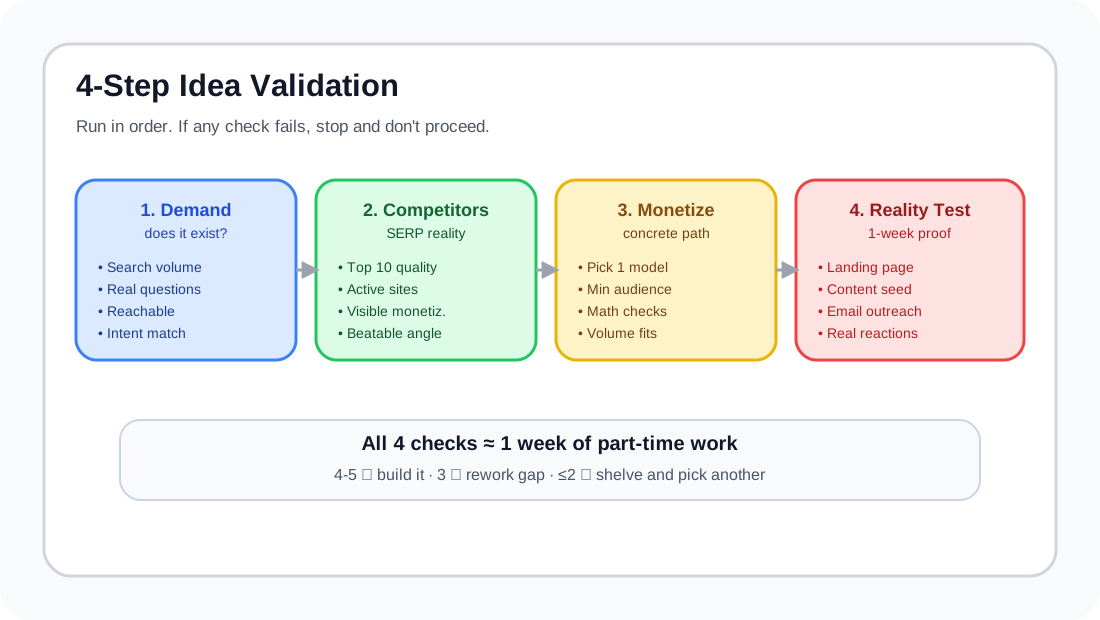
The 4 checks, in order
Run these in sequence. If any check fails, stop. Don’t move to the next.
Check 1: Demand exists and is reachable
The first question isn’t “would people buy this?” It’s “do real people search for this?” Two hours of work:
Sub-check 1.1: Search volume on the core terms
Pick 3-5 phrases that capture the core intent. Search them on Google Keyword Planner (free with Google Ads account), Ahrefs Webmaster Tools, or just Google directly. Look for:
- Combined monthly volume ≥ 1,000 for English niches, ≥ 500 for Chinese niches
- At least 1 phrase with stable or rising trend (not declining)
- Search intent matches what you’d offer (informational vs commercial vs transactional)
Volume below the threshold isn’t always fatal, but you need an alternative reach plan (community, social, paid). For SEO-driven indie websites, low search volume = low ceiling.
Sub-check 1.2: Real questions exist
Search Reddit, Stack Exchange, niche forums, or X for the topic. You’re looking for people asking actual questions not just commenting. If a niche has zero questions in 3 months across all major communities, the demand is probably non-existent or already perfectly served.
Failure mode: only marketing tweets and self-promotional posts surface. That means there’s chatter but no need.
Check 2: Competitor reality check
The instinct is to celebrate “no competitors found.” That’s actually a red flag. Run this check honestly:
Sub-check 2.1: Search top 10 results for your core phrase
What does the SERP look like?
- Filled with high-quality, clearly-monetized content → competitors validated demand for you, but you need a clear differentiation angle
- Filled with thin AI-generated junk → opportunity exists, you can win on quality
- Filled with old (5+ year) results that haven’t been updated → strong opportunity for refreshed content
- Empty / dominated by Reddit threads / completely unrelated → demand may be too small to monetize
Sub-check 2.2: Active competitor list
Find 3-5 real businesses in this niche. They:
- Have published in the last 90 days
- Have visible monetization (ads, affiliate, products, services)
- Show signs of revenue (active social, hiring, paid features)
If no active business exists, ask yourself: did everyone fail or was it never viable? Sometimes “no competitor” means the market refused to convert.
Failure mode: every competitor is a giant content site (Wirecutter, NYT, etc) — you can’t outrank them, your only play is paid acquisition or a different angle.
Check 3: Monetization path is concrete
You need to know how money will flow before you build. Not “I’ll figure it out later” — that’s the most common failure. Pick one primary path:
| Path | Best for | Min audience to break even |
|---|---|---|
| Display ads | High-volume informational content | 50k pageviews/month |
| Affiliate links | Comparison / review sites | 10k targeted visits/month |
| Lead generation | Service businesses, B2B | 100 qualified leads/month |
| Digital product | Specific niche audiences | 200-500 buyers/year |
| SaaS / membership | Recurring problem solvers | 50-100 paying users |
| Sponsorships | Niche authority sites | 5-10k engaged subscribers |
Each path has a specific minimum audience you need to reach for it to work. Calculate yours:
Required revenue / month = $X
Target conversion rate = Y%
Required visits = X / (Y% × avg revenue per conversion)
If your math says you need 200k visits/month and your search volume check showed 1,500 — your monetization model doesn’t fit your demand. Pick a different model or a different idea.
For comparison-style monetization see affiliate content vs service lead generation which walks through path selection.
Check 4: 1-week reality test
Before building anything, run an actual test. The point isn’t to acquire users — it’s to see if the idea generates any reaction at all.
Pick one of these tests based on idea type:
Test A: Landing page test (3 days)
Build a simple landing page (no real product, just description + email signup). Drive 100-300 visits via Reddit / Twitter / niche forum / paid ads ($20-50). Track signup rate. Anything > 5% = real interest. < 1% = idea has no pull.
Test B: Content seed test (5-7 days)
Write one detailed article on the topic, post on Medium / dev.to / Reddit / niche community. Watch:
- Real engagement (comments asking follow-up questions, not just upvotes)
- DMs from people interested in more
- People sharing it in other contexts
This tests whether the topic has organic pull, separate from search.
Test C: Email outreach test (3-5 days)
For service / B2B ideas: cold email 50 prospects with a single sentence describing the offering. Track:
- Reply rate (any reply, even “not interested”)
- Reply tone (curious vs dismissive vs annoyed)
- 5+ replies = signal of interest, plan a real conversation
Failure mode for all 3 tests: zero engagement, zero replies, zero clicks. That’s a clear kill signal — the idea isn’t interesting to anyone.
What “passing” looks like
After 1 week, you should have:
- ✅ Search volume validated (≥ threshold)
- ✅ Real conversations / questions found in communities
- ✅ At least 1 active competitor proving viability + a differentiation angle
- ✅ Concrete monetization path with feasible audience target
- ✅ A 1-week test produced > 0 engagement
If 4-5 are ✅: build it.
If 3 are ✅: rework the gap, re-test before building.
If ≤ 2 are ✅: shelve the idea, pick another.
Common validation mistakes
Mistake 1: Validating with friends and family — they tell you what you want to hear. Always test with strangers in the actual target community.
Mistake 2: Skipping competitor check — “I just feel this is needed” is not validation. The market either confirmed need (competitors exist) or refused need (they don’t).
Mistake 3: Confusing interest with willingness to pay — people will say “great idea” and never buy. Test landing page or paid signal, not “would you use this?” surveys.
Mistake 4: Building before testing — code is the most expensive way to learn whether an idea works. A landing page costs $20 and 3 hours.
Mistake 5: Validation paralysis — running 5 tests before 1 succeeds. After 2-3 weeks of testing, commit or kill. Don’t validate forever.
What to do once validated
If your idea passed all 4 checks:
- Pick the website stack — see how to build a website for small business
- Pick the SEO tool stack — see Indie Hacker SEO Stack 2026
- Map out content topics — start with the search phrases you validated
- Set 90-day milestone with measurable target (X visits, Y signups, Z revenue)
- Re-validate at day 90 — if numbers don’t match, don’t double down on the same approach
What to do if it failed
Failing validation is the win. You just saved 6 months. Three options:
- Pivot the angle — same niche, different intent (e.g., from “tutorial site” to “tool comparison”)
- Pivot the niche — same monetization model, different audience
- Park and start over — some ideas just don’t work; the discipline is to accept it
For idea generation, see niche ideas, business website ideas, and blog niche ideas.
Further reading:
- After validation passes: new site SEO checklist and on-page SEO checklist
- Idea inventory: niche ideas, business website ideas
- Monetization decision: affiliate content vs service lead generation
- Tool budget: Indie Hacker SEO Stack 2026